Cosmetic packaging is required to do so much more than make a cosmetic product look appealing on a retail shelf. It helps to preserve the formulation, maintain the quality of the product, convey important information and must withstand handling from the factory to the consumer. Any of these can result in leak, contamination, product damage, or customer complaints.
This is more difficult when cosmetics are shipped long distances and to various markets. Packaging can be subjected to vibration, temperature fluctuations, pressure shifts, stacking and multiple handling while being moved. A package that works well in the factory can act in very different ways once it is put into a real-world supply chain. That’s why technical packaging evaluation must take into account the quality of manufacturing and the actual use conditions.
Why Packaging Failure Analysis Matters in Cosmetics
Cosmetic products may contain oils, alcohols, acids, fragrances, preservatives and other ingredients which may interact with packaging materials. A bottle, tube, pump, cap or liner that is seemingly fine after visual inspection may slowly deteriorate when exposed to the formulation. Over time cracking, swelling, discoloration, deformation and seal failure can occur.
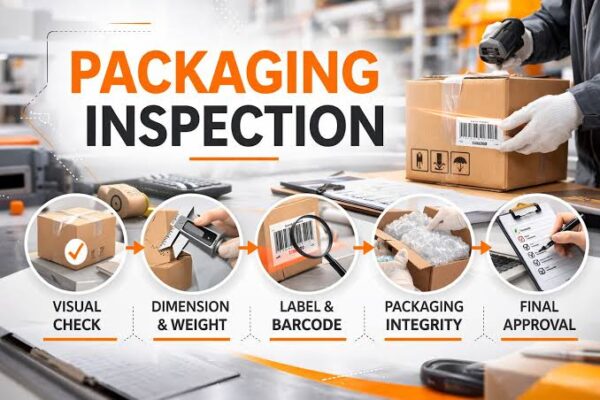
This is where Cosmetics packaging inspection comes into play. Inspectors assess if packaging materials are compliant with specified requirements and if the package will ensure product protection over the shelf life. Early detection of weaknesses can prevent manufacturers from incurring the costs of recalls, rejected shipments, and tarnished brand reputation.
Evaluating Seal Integrity and Leakage Risks
Seal integrity is a key technical aspect of cosmetic packaging. Pumps, tubes, jars and bottles, and flexible containers all rely on well designed closures or seals to keep product from leaking and outside contaminants from entering. A small imperfection in a sealing surface can be a big issue while in transit.
Pressure testing, vacuum testing, dye penetration, torque measurement, and controlled leakage assessments are all types of testing that may be performed. The method to be used will depend on the type of package and the formulation. The results should be compared to set acceptance criteria and not just visually. For instance, slight differences in cap torque or sealing pressure can have a huge impact on package performance.
Material Compatibility and Product Interaction
Packaging materials need to be stable in contact with cosmetic formulations. Compatibility testing checks to see if the container, closure, liner, adhesive or other component is reactive to the product. This is especially vital for formulations with aggressive solvents, essential oils, alcohol or high levels of active ingredients.
Changes in package weight, size, color, surface, flexibility and mechanical strength can be evaluated in a compatibility assessment. Changes in appearance, smell, feel (consistency) or other pertinent properties of the formulation should also be monitored. These tests are used to assess the packaging’s ability to provide protection during the package’s proposed storage time.
Key Tests for Packaging Durability
Packaging mistakes are not always made in the warehouse. Physical forces may be added during transportation which are not present during production or storage. Products can be dropped, compressed, vibrated, stacked or exposed to temperature variations. Testings of these conditions can give manufacturers valuable information on the performance of packaging in distribution.
- Drop Testing: Assesses the container and closure’s ability to withstand accidental impacts.
- Compression Testing: Measures resistance to stacking pressure in storage and transportation.
- Vibration Testing: Reproduces the vibration that the product receives during transportation by road, rail, air or sea.
- Temperature Testing: Tests how packages perform in various temperature environments.
- Torque Testing: Ensures that caps and closures are opened and sealed at a proper torque.
- Seal Testing: Establishes if the packaging is leak resistant under specified conditions.
The combination of several tests will give a more comprehensive picture of packaging reliability. A container can pass a drop test and fail subsequent to prolonged vibration, for instance. A combination of different test methods thus provides a manufacturer with a more complete picture of where failure may occur.
Common Causes of Cosmetic Packaging Failures
Several points in the manufacturing process can give rise to packaging problems. The molding process could result in weak points, and the dimensions could vary, which could impact the fit of the components. Problems can also be caused by incorrect closure torque, contaminated sealing surfaces or unsuitable materials and only become apparent when the product is in distribution.
Another common one is not testing enough during the product development process. Sometimes, manufacturers put a lot of emphasis on the look and less on mechanical performance or compatibility of formulation. A package may appear to be high quality but may not be appropriate for the environment in which it is to be used. Technical evaluation should be a balance of aesthetics, function, durability, and product protection.
Building a Reliable Packaging Quality System
A good packaging quality program starts at the design phase, not after production has commenced. Packaging engineers must identify potential failure modes, set up measurable specifications, and decide on appropriate tests for each packaging element. Supplier controls are also crucial as material or component dimensions may vary and impact the final performance.
Testing should also be ongoing after the initial approval. Production batches should be monitored accordingly to make sure that manufacturing changes, tooling changes or material changes do not add new risks. If inspection results are linked to corrective and preventive action systems, the manufacturer can determine if there are recurring issues and enhance the reliability of the packaging over time.
Conclusion
For cosmetic packaging to be reliable, it must be more than just pretty. It needs to be evaluated in terms of engineering, seals, materials, mechanical strength, and transportation performance. Manufacturers can minimise waste, preserve formulations and ensure a more consistent customer experience by identifying potential failure modes prior to product entering the supply chain.
A Packaging quality inspection program is a valuable last step in ensuring that packaging meets specified quality and performance standards. It can be used in conjunction with the right lab testing, process controls and ongoing monitoring to enable cosmetic companies to develop packaging that can hold up to the rigors of today’s global supply chain.